

.jpeg)
.png)
Bad luck with a nice bull led Lincoln Pochop to find a breed that worked better on his family ranch near McDonald, Kansas.
Pochop knew after he earned his farm and ranch management degree and associates in agricultural science degree from Colby Community College, that he was meant to work outdoors and in agriculture.
He works closely with his parents, Gerard and Anita, having built the farm up from his dad’s small herd.

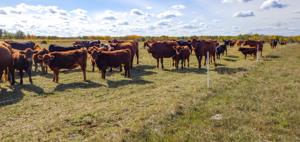
Cattle graze on the Pochop Ranch near McDonald, Kan.
“When I came back, we did not farm a lot at that time. Dad also had around 80 to 100 cattle, and I knew I could help him, but I was also going to have to figure something out on my own, too,” Pochop said.
It all started with some replacement heifers his father helped him secure. His dad had bought a nice yearling bull and sent him out with the heifers.
“Within 90 days, we didn’t recognize the bull anymore. It just fell to pieces,” he said.
That’s when Pochop got into the seedstock business. Looking to build something that would last, he aimed to breed animals that didn’t need pampering.

A calf feeds from its mother on the Pochop Ranch in Kansas.
“Our motto is, ‘Sound, reliable, and built to last,’” Pochop said. “We have focused since on raising cattle that are working for us. We are not working for them.”
The Pochops fall calve in September and October and spring calve in April and May. The fall herd stays on grass year-round. The spring herd runs on stalks during the wintertime, and the Pochops feed from mid-to-late March to the first of June, but they are working to shorten that time.
Attending soil health conferences and seeking resources is how the Pochops are learning how to maximize their management. It’s a reason they sought Graze Master genetics and tuned into soil health practices with consulting from Graze Master Transitional Ag Consulting Services.
Consultant Del Ficke appreciated that the Pochop’s cattle were 1,150 to 1,250 pounds, which leads to more efficiencies in the way they graze, more in tune with nature.

Lincoln Pochop said his biggest goal is to make sure he and his wife Brenda and their children, Landon, Breckyn, and Leo, stay close-knit as a family first.
The Pochops are well on their way in the soil health and cattle arena and are always seeking to diversify. In addition to the cattle operation, they farm wheat, milo, corn, oats and are drilling sorghum Sudan as a cover crop to graze this winter. “We figure with the way the commodity prices are looking, and the cattle prices are looking, it’s wise to keep the cattle around and to keep working on improving our management of them,” Pochop said.
This year, the Pochops expanded to around 450 acres of cover crops for grazing. In addition to sorghum Sudan, the cattle will eat mung beans, sunflowers, Sunn Hemp, and German millet.
They have experimented with intensive grazing. They took about 50 acres out of a bigger pasture and divided it up to graze a portion of the time and yo allow the other part to rest and see if the grass comes back any stronger.
Last winter they grazed milo stalks and gave the cows six to 10 acres for three to five days.
“It’s just Dad and I, so the daily moves aren’t going to be as feasible because days just don’t always go as planned,” Pochop said.

The extended Pochop family gathers for a portrait.
Pochop said his biggest goal is to make sure he and his wife Brenda and their children, Landon, Breckyn, and Leo, stay close-knit as a family first.
Their operation today looks different than when Pochop was getting started in 2012. At that time they fed cows year-round.
“It was during the drought that I kept asking myself, ‘Why are we doing this?’” he said. “The first cattle check I got; the whole thing went back to feed. That’s why the changes we are making now with our grazing management make so much more sense.”
Their goal is to have fewer feeding days and to graze the cattle on what feed they already have.
“We don’t need more land because more land doesn’t always equate to more money. It’s about management,” Pochop said.
On the farming side, he tries to work with what he has, too. They switch crop rotations to accommodate changing weather patterns.
“Just because wheat went into a field for one year, does not mean a fall commodity will go there again the following year,” he said. “We are going to do what’s best for the soil and what makes sense.”
He’s also found opportunities in what originally seemed like a challenging situation.
One year, an oat field get really weedy. With organic production, there was no option of spraying it. Instead, they brought the cows out and grazed it.
“We saved money on feeding cows and took care of the weed problem,” Pochop said.
It might have looked terrible for a while, but it worked out in the end. Through such trials, along with some solid advice and a good network of mentors, the Pochops are finding what works for them.
Kerry Hoffschnieder is a founder of the Lincoln, Nebraska-based GrazeMaster Group, who writes Hope Stories to show that caring for the soil and all natural resources is possible, profitable and benefits all life on earth. Reach her at kerry@grazemaster.com or visit grazemastergroup.com.
Be the first to know
Get local news delivered to your inbox!



.png)
