
 1 month ago
69
1 month ago
69

.jpeg)
.png)
Every poultry farm starts with a chick, and every chick starts in a hatchery. Understanding how fertile eggs become day-old chicks (D.O.C) is valuable knowledge for any poultry farmer, whether you plan to run your own hatchery operation or simply want to make more informed decisions when buying stock from a supplier.
A hatchery is a facility specifically designed and equipped for hatching fertile eggs to produce day-old chicks. The scale of a hatchery depends largely on the size of the incubators used and the volume of chicks required. Large commercial hatcheries supply thousands of chicks per week to farms across a wide region, while small-scale hatcheries may serve local farmers in a specific area. Either way, the fundamental processes involved are the same.
At the center of any hatchery is the incubator, a controlled-environment chamber that replicates the conditions a broody hen would provide naturally. Incubators maintain precise temperature and humidity levels and turn the eggs at regular intervals to ensure even development of the embryo. There are two distinct types of incubators used in the hatching process: the setter incubator and the hatcher incubator. Each handles a specific stage of the chick’s development and operates under slightly different conditions.
The journey from fertile egg to a healthy, vaccinated, and market-ready day-old chick passes through several carefully managed stages: egg collection and selection, fumigation, cold storage, incubation, candling, transfer to the hatcher, hatching, and finally vaccination. Each stage must be handled correctly for the process to produce chicks of the quality that farmers need to start a productive flock.
This article walks through the full hatchery procedure step by step, from the breeder flock that produces the fertile eggs all the way through to the checklist a farmer should use when buying day-old chicks from any supplier.
Read Also: How to Handle the Arrival of Day Old Chicks (D.O.C)
1. The Breeder Flock and Egg Production
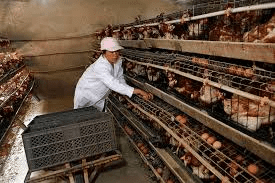
The production of day-old chicks begins with the breeder flock. A breeder flock consists of both cocks and hens housed together in deep litter houses. Their primary role is to produce fertile eggs consistently and in sufficient numbers to meet the hatchery’s production targets.
The ratio of cocks to hens is critical for achieving good fertilization rates. The standard breeder ratio is one cock to every ten hens. So if you are housing 1,000 hens, you should be running 100 cocks alongside them. Getting this ratio wrong, either too few cocks or too many, reduces fertilization rates and results in a higher proportion of infertile eggs, which directly affects hatchery output and profitability.
Eggs are collected from the deep litter houses and taken through a series of preparation steps before they can be set in the incubator. Only eggs that meet specific quality standards are selected for hatching. A good hatchable egg is medium-sized with no deformities, has a thick and intact shell, and is visibly clean. Eggs that are irregularly shaped or oblong, have dirty or cracked shells, or show any other visible defect are rejected. Setting poor-quality eggs wastes incubator space and reduces the overall hatch rate.
Selected eggs are arranged in setting trays with the pointed end facing downward. This positioning is important for correct embryo development and must be maintained consistently throughout the pre-incubation stages.
2. The Hatchery Procedure: Step by Step
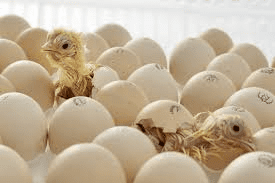
Once eggs have been collected and selected, they pass through the following stages before chicks are ready for sale:
A. Fumigation
Before entering cold storage or the incubator, selected eggs are fumigated to eliminate surface bacteria and other pathogens that could penetrate the shell and damage the developing embryo.
i. Method: Eggs are treated with carbolic acid for 5 to 10 minutes in a dedicated fumigation room. This disinfection step is essential for maintaining hatch quality and reducing the risk of early embryo mortality caused by bacterial contamination.
B. Cold Room Storage
After fumigation, eggs are transferred to a cold room where they are held under controlled conditions until they are ready to be set in the incubator.
i. Duration: Eggs remain in the cold room for 7 days before being moved to the setter incubator.
ii. Conditions: Temperature is maintained at approximately 55°F and humidity is kept between 60 and 70 percent. These conditions slow metabolic activity within the egg, preserving viability without triggering development.
C. Setter Incubator
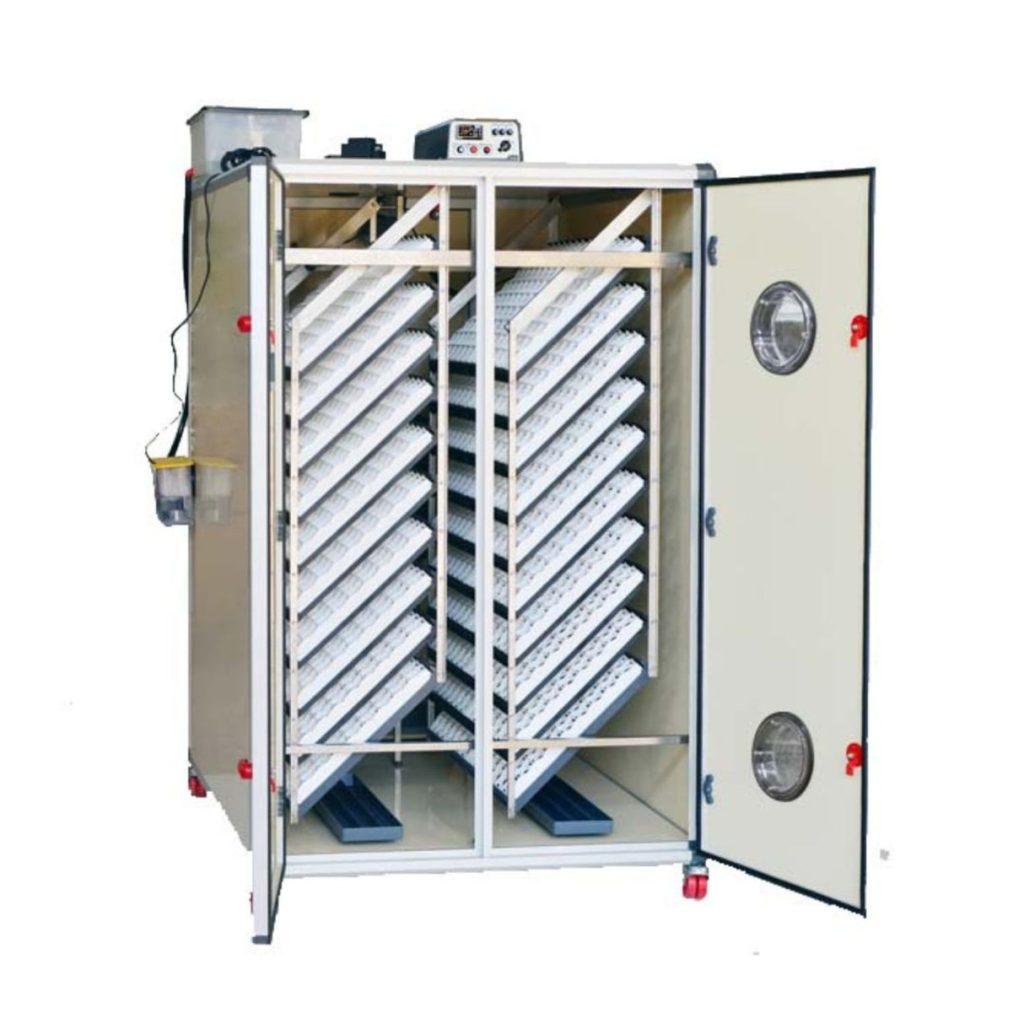
After 7 days in cold storage, eggs are transferred to the setter incubator where the active development of the embryo begins.
i. Duration: Eggs remain in the setter incubator for 18 days.
ii. Temperature and Humidity: The setter incubator is maintained at 99.5°F with humidity at 60 to 70 percent throughout this phase.
iii. Egg Turning: Eggs are turned automatically every 3 hours by the setter incubator mechanism. Regular turning prevents the embryo from sticking to the inner shell membrane and ensures even heat distribution across the egg, both of which are critical for healthy development.
D. Candling Room
After 18 days in the setter incubator, eggs are removed and taken to the candling room for testing before they are moved to the hatcher.
i. Purpose: Candling distinguishes fertile eggs from infertile ones. Under a candling lamp, fertile eggs appear dark internally because the developing embryo and its blood vessels block the light. Infertile eggs remain clear or transparent under the lamp, confirming no development has taken place.
ii. Removal of Infertile Eggs: All infertile eggs identified during candling are removed from the trays. This creates adequate space between the fertile eggs, which improves air circulation and allows the hatcher incubator to maintain optimum humidity during the final hatching phase.
E. Hatcher Incubator
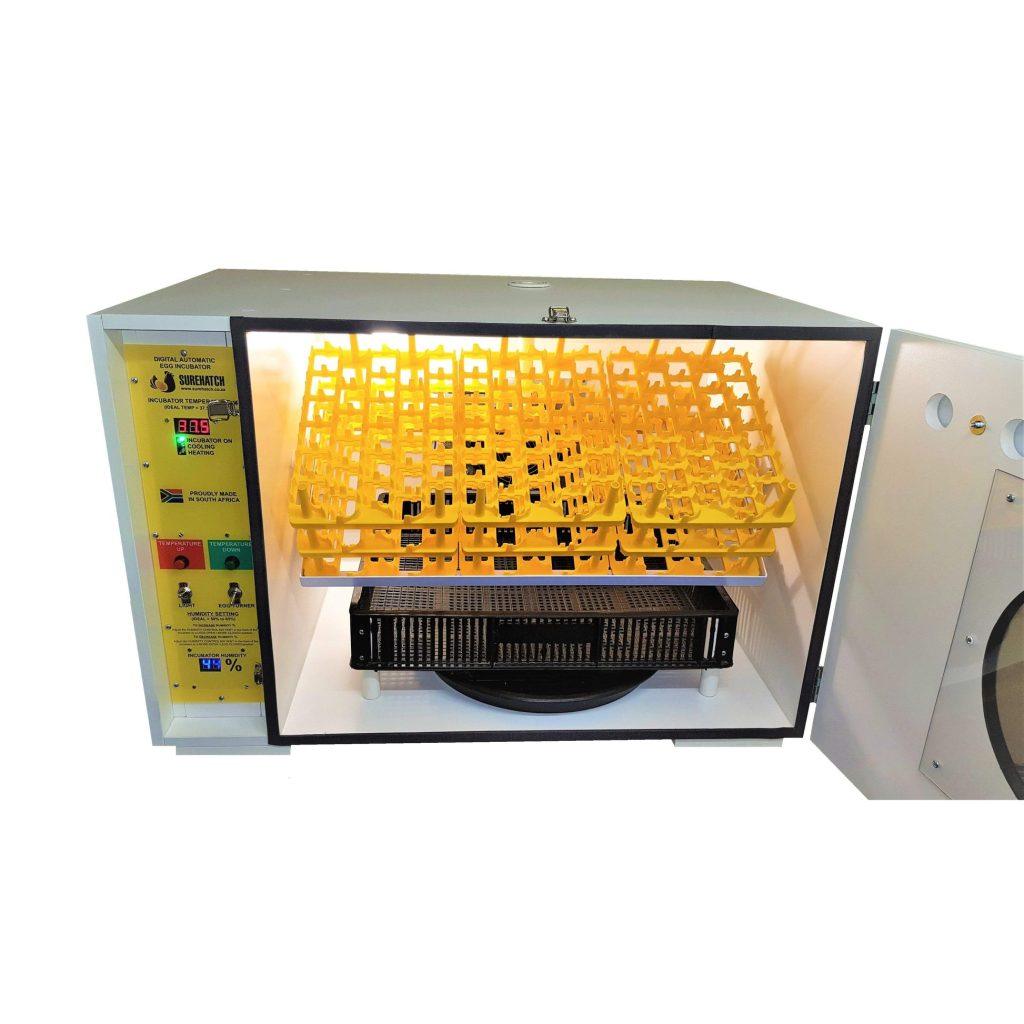
Fertile eggs confirmed through candling are transferred to the hatcher incubator where the final phase of development and the hatching process take place.
i. Duration: Eggs remain in the hatcher incubator for 3 days.
ii. Temperature and Humidity: The hatcher incubator operates at a slightly lower temperature of 98.5°F, with humidity maintained at 60 to 70 percent. The reduced temperature supports the natural cooling the embryo requires as it prepares to hatch.
iii. Hatching: By the end of the third day in the hatcher, the chicks break through their shells and emerge as live, active day-old chicks.
F. Vaccination and Sale
Once hatched, the chicks go through one final step before they are ready to leave the hatchery.
i. Vaccination: Newly hatched chicks are vaccinated with an intra-ocular (I/O) vaccine, which is administered directly into the eye. This provides the chicks with early protection against Newcastle Disease, one of the most serious viral threats in poultry production.
ii. Sale to Farmers: After vaccination, chicks are packaged and sold to farmers as day-old chicks. Farmers are strongly advised to purchase their D.O.C only from reputable hatcheries with a track record of producing healthy, vaccinated stock. If chicks arrive unvaccinated, a veterinarian should be contacted immediately to administer the necessary vaccines without delay.
Read Also: Comprehensive Guide on How to Start Cockerel Farming Business
3. What to Check When Buying Day-Old Chicks

Not all day-old chicks are of equal quality. Buying weak, poorly vaccinated, or unhealthy chicks is one of the fastest ways to get a poultry farm off to a bad start. Before accepting any batch of D.O.C from a hatchery or supplier, every farmer should inspect the chicks carefully and look for the following signs of good health and quality:
i. Bright, Round, Alert Eyes: The eyes of a healthy day-old chick should be wide open, round, and responsive. Dull, half-closed, or sunken eyes are a sign of weakness, dehydration, or early illness.
ii. Well-Spread Toes and Legs: The toes should splay naturally and the legs should be straight with no signs of curling, splaying in an abnormal direction, or difficulty standing. Leg and toe defects affect the chick’s ability to access feed and water and can worsen over time.
iii. Nostrils and Eyes Free of Discharge: There should be no mucus, crustiness, or any form of discharge around the nostrils or eyes. Discharge in these areas is a strong indicator of respiratory infection or other illness that may spread rapidly through a newly placed flock.
iv. Freedom from All Defects: Examine each chick for any visible physical abnormality including crooked beaks, swollen joints, protruding navels, or signs of injury. Defective chicks have poor survival rates and should not be accepted as part of a paid delivery.
v. Eating and Drinking Actively: Healthy day-old chicks show an immediate interest in feed and water when placed in the brooder. Chicks that are passive, uninterested in food, or slow to find the drinkers are already compromised and are at high risk of failing to thrive in the first critical week of life.
Do you have any questions, suggestions, or contributions? If so, please feel free to use the comment box below to share your thoughts. We also encourage you to share this information with others who might benefit from it. Thank you for your support!
Summary on How to Hatch Fertile Eggs into Day Old Chicks
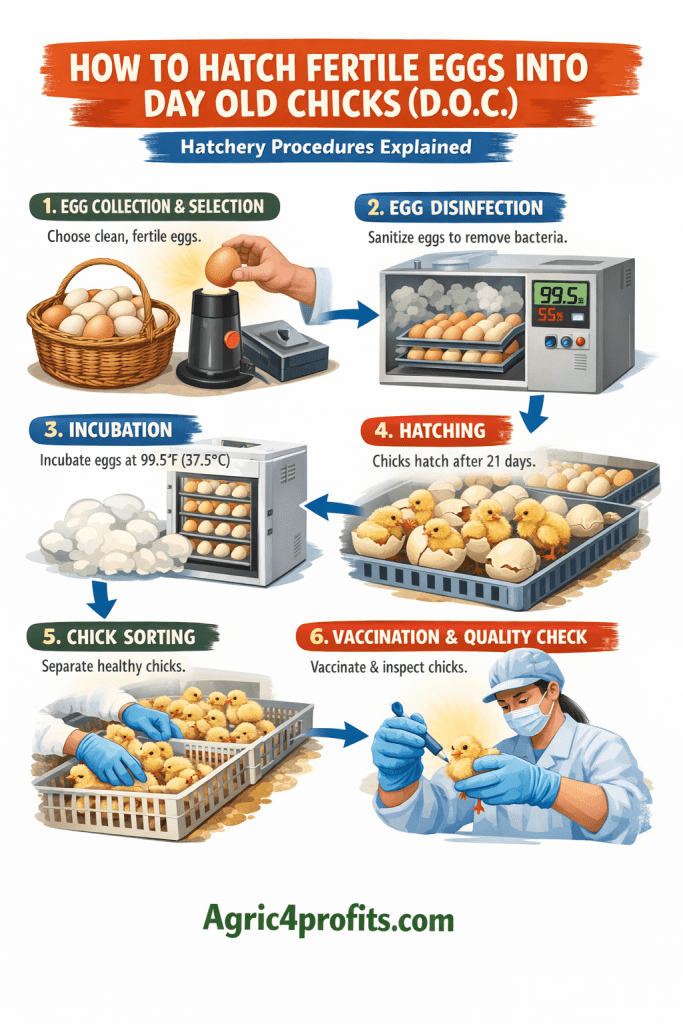
| What is a Hatchery | A facility for hatching fertile eggs to produce day-old chicks; scale depends on incubator size and production volume |
| Types of Incubators | Setter incubator (18 days, 99.5°F) and hatcher incubator (3 days, 98.5°F); each handles a distinct phase of development |
| Breeder Flock Ratio | 1 cock to every 10 hens; essential for achieving adequate fertilization rates in the breeder flock |
| Egg Selection | Select medium-sized, clean, thick-shelled eggs with no deformities; pointed end placed downward in setting trays |
| Fumigation | Treat with carbolic acid for 5 to 10 minutes to disinfect the shell surface before cold storage |
| Cold Room Storage | 7 days at 55°F and 60 to 70% humidity; slows metabolism and preserves egg viability before incubation |
| Setter Incubator | 18 days at 99.5°F and 60 to 70% humidity; eggs turned automatically every 3 hours for even development |
| Candling | After 18 days; fertile eggs appear dark under the lamp; infertile eggs are removed to improve air circulation |
| Hatcher Incubator | 3 days at 98.5°F and 60 to 70% humidity; chicks hatch by end of day 3 |
| Post-Hatch Vaccination | Intra-ocular (I/O) vaccine administered immediately after hatching; chicks are then ready for sale to farmers |
| D.O.C Quality Checklist | Bright eyes, well-spread toes, no discharge, no physical defects, actively eating and drinking |
Frequently Asked Questions About How to Hatch Fertile Eggs into Day Old Chicks
1. What is a hatchery and how does it work?
A hatchery is a facility designed to hatch fertile eggs under controlled conditions to produce day-old chicks for sale to poultry farmers. It uses incubators to replicate the warmth, humidity, and egg-turning that a broody hen would provide naturally, but on a much larger and more consistent scale.
2. What is the difference between a setter incubator and a hatcher incubator?
A setter incubator handles the first 18 days of incubation at 99.5°F, during which the embryo develops fully. A hatcher incubator handles the final 3 days at 98.5°F, during which the chick breaks through the shell. The two units operate at different temperatures and serve distinct stages of the process.
3. Why is the cock-to-hen ratio important in a breeder flock?
The ratio directly affects the fertilization rate of eggs. The standard ratio is 1 cock to every 10 hens. Too few cocks means many eggs will be infertile and cannot hatch. Too many cocks leads to excessive mating, stress, and injury in the hens, which also reduces egg quality and production.
4. How do you identify a good hatchable egg?
A good hatchable egg is medium in size, clean, has a thick and intact shell, and shows no deformities. Eggs that are irregularly shaped, cracked, dirty, or have abnormally thin shells should be rejected. Selected eggs are placed in trays with the pointed end facing downward.
5. Why are eggs fumigated before being placed in the incubator?
Fumigation removes surface bacteria and pathogens from the shell that could penetrate into the egg during incubation and kill the developing embryo. The process uses carbolic acid applied for 5 to 10 minutes and is a standard disinfection step in professional hatchery management.
6. What is the purpose of the cold room in the hatchery process?
The cold room stores fumigated eggs for 7 days at 55°F and 60 to 70 percent humidity before they are set in the incubator. This controlled storage slows the egg’s metabolism without triggering development, allowing the hatchery to batch eggs efficiently and set them in the incubator at the right time.
7. Why are eggs turned every 3 hours in the setter incubator?
Regular turning prevents the developing embryo from sticking to the inner shell membrane and ensures even heat distribution throughout the egg. Failure to turn eggs consistently is one of the most common causes of poor embryo development and reduced hatch rates.
8. What is candling and why is it done?
Candling involves shining a bright light through the egg after 18 days in the setter incubator. Fertile eggs with a developing embryo appear dark because the embryo and its blood vessels block the light. Infertile or dead eggs remain clear. Infertile eggs are removed before the fertile ones are transferred to the hatcher, improving air circulation and hatch conditions.
9. What vaccine is given to chicks immediately after hatching?
Newly hatched chicks are given an intra-ocular (I/O) vaccine, administered directly into the eye. This provides early protection against Newcastle Disease, a highly contagious and potentially fatal viral infection. If you buy chicks that have not been vaccinated, contact a veterinarian immediately to arrange vaccination.
10. What should I look for when buying day-old chicks?
Healthy day-old chicks should have bright, round, alert eyes; well-spread, straight toes and legs; clean nostrils and eyes with no discharge; no visible physical defects; and active interest in eating and drinking when placed in the brooder. Chicks that fail any of these checks should not be accepted from the supplier.
Do you have any questions, suggestions, or contributions? If so, please feel free to use the comment box below to share your thoughts. We also encourage you to kindly share this information with others who might benefit from it. Since we can’t reach everyone at once, we truly appreciate your help in spreading the word. Thank you very much for your support and for sharing!
Read Also: The Products Derived From Commercial Wastes









.png)
