

.jpeg)
.png)
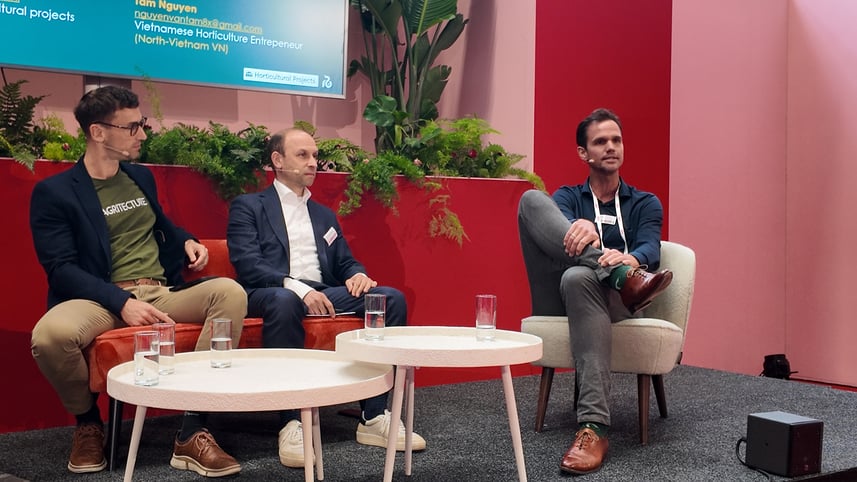
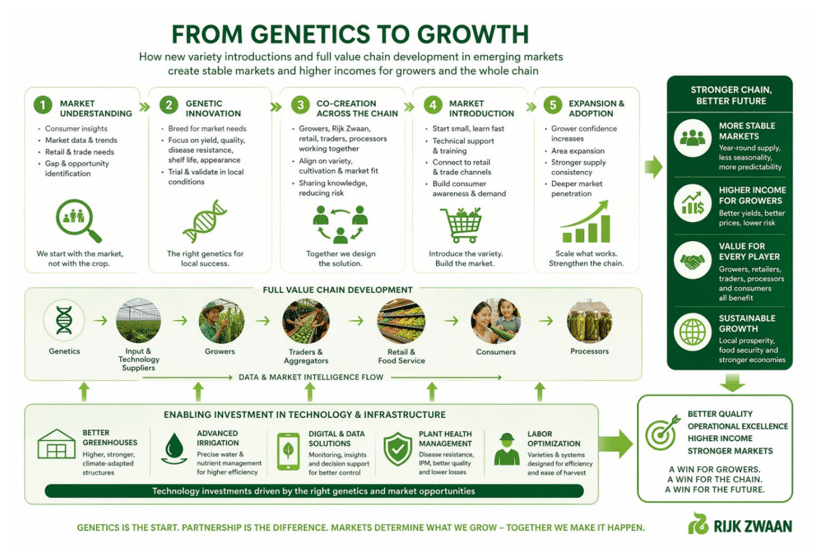
How Rijk Zwaan’s Vietnam case shows that the riskiest bet in emerging market horticulture isn’t the crop , it’s assuming the market already exists. At Greentech Amsterdam on June 9, 2025, Rijk Zwaan took the Vision Stage not to talk about seeds, but to talk about markets. The case: a 200-grower community in Vietnam producing melons they couldn’t sell profitably in winter. Four years later, those same growers cultivate cucumbers across 100 hectares, connected to retail, and earning higher prices with greater income stability. It’s a financing story, a market-creation story, and an instruction manual. When Rijk Zwaan analyzed the situation, the instinct might have been to find a better melon variety. Instead, they ran a market analysis first. The question wasn’t “can we grow cucumbers?” It was: “what kind of cucumber does the market need?” Commodity cucumbers already existed in Vietnam. What the market lacked was a differentiated product: a Japanese-style cucumber with defined specs around length, quality, packaging, and shelf life. Rijk Zwaan’s marketers identified that unmet demand signal before breeders selected a variety. The genetics came second — an inversion rare in a sector where seed development typically drives commercial strategy. “Our journey starts in the marketplace. We have chain managers who interact with retailers and processors to understand specifications, then work back to what’s needed for growers — and then long-term strategies for breeding.” — Damion Schwarzkachel, Client Manager Horticultural Projects, Rijk Zwaan One important context: Vietnam's fresh produce market still runs predominantly through informal channels — wet markets, wholesale traders, neighbourhood greengrocers. As Friso Klok noted on stage, only 8% of fresh produce reaches modern retail. That matters for how you build a market: a strategy anchored purely in supermarket listings would bypass the channels where 92% of volume actually moves. Rijk Zwaan's approach accounts for both — developing retail relationships for the premium end while keeping growers connected to the traditional trade they depend on for volume. Once the target product was defined, the agronomic challenge became specific: low light, high disease pressure, and a labor cost structure that punishes low-yield varieties. They started with a mini cucumber and shifted to a longer Japanese variety because the labor math demanded it. Hung Ta, Rijk Zwaan Vietnam’s Production Development Specialist, explained the shift: “The snack cucumber became a commodity. The Japanese variety, one fruit per node, easy to harvest, and adapts very well to low light and low temperature, gives the grower stable harvesting during the difficult winter time.” He added that crunchy texture is non-negotiable in Vietnam: “Anything you hear, even cucumber should be crunchy. The Japanese variety delivers that better than others.” Genetics and market fit are not sequential decisions. They are a single system. A variety that performs agronomically but fails at retail is not a good variety. The Rijk Zwaan model runs trials alongside retail conversations, local data as the evidence base for growers and financiers alike. The case scaled from 1 to 100 hectares in four years, not because a seed performed well in a trial, but because the full chain was built first: variety selection co-designed with growers and traders, retail relationships established ahead of harvest, technical support embedded through the growing season. Tam Nguyen, the Expert in Agricultural Development who led the grower community, described how it spread: “In Vietnam, if a good grower in a community is doing well, many people will follow very fast.” A tightly organized group of over 300 growers turned one successful season into a regional movement. The knowledge and confidence scaled with the crop. For investors evaluating emerging market CEA or protected horticulture, this is the de-risking structure that works. The persistent failure mode is projects built on strong agronomic assumptions with no pre-existing demand architecture. The crop grows. The market doesn’t absorb it at the modeled price. The business case collapses. Friso Klok was direct on the new-entrant risk: “New players struggle sometimes in Asia. Five or six years ago there was a boom, new money, new projects. Many of those, once they hit reality and didn’t make their decisions right, were hard to make successful. Existing players with incremental improvements can be very well successful.” Community-embedded growers with a proven market channel are a far lower-risk entry point than greenfield plays, however compelling the agronomic thesis. The five-step model, market understanding, genetic innovation, co-creation across the chain, market introduction, expansion and adoption, is a multi-year commitment requiring embedded agronomists, marketers, and client managers in a single geography. Most seed companies develop varieties and sell through distributors. The Rijk Zwaan model converts the seed company into a market development partner, accountable for commercial success, not just trial performance. Friso Klok named the four barriers the model must address simultaneously: “lack of available technologies, lack of knowledge, lack of market, and lack of capital. If those four factors are not there, a project will not be successful.” The implication for governments and development institutions: subsidizing seeds is less durable than funding the co-creation infrastructure, the knowledge transfer, market linkage, and retail introduction, that makes a new crop commercially viable. Vietnam’s cucumber growers didn’t need a voucher. They needed a structured pathway from variety selection to shelf. The next moves: connecting the cucumber program to processing off-takers to stabilize year-round demand, and using that demand stability to justify infrastructure upgrades, better greenhouses, advanced irrigation, digital farm management tools. “You can really see how the genetic input starts building an emerging market that is not only a new variety — it’s also building a new ecosystem of solutions and technology which enables the farmers to grow, the traders to grow, and the retailers to grow on their assortment.” - Damion Schwarzkachel, Rijk Zwaan Infrastructure investment follows market certainty, not the other way around. Most indoor production in Vietnam is currently low-to-mid-tech, plastic cover, steel structure, around $20/sqm capex. High-tech is still the exception, but the conversation is shifting as growers with stable income streams start investing in climate control and irrigation. The earnings stability the cucumber program delivers is the precondition for the technology upgrade cycle to begin. Southeast Asia’s agricultural sector, valued at around USD 400 billion and contributing roughly 12% of the region’s GDP, is projected to grow by 25% through 2031, driven by digital tools, export diversification, and strong government support. That market is large enough to absorb significant investment in differentiated horticulture, but only where the supply chain delivers consistent, specification-grade product to the buyers who will pay for it. The growers in Tam Nguyen’s community are now earning higher prices with more income certainty across two crop cycles per year. That outcome wasn’t the product of a new seed catalog. It was the product of a company deciding to build the market before it asked growers to grow for it. That’s the model worth understanding, and the one worth replicating.The problem wasn’t the crop. It was the market model.
Why genetics is a market-access problem in disguise
What 1 hectare to 100 tells an investor

The co-creation model and what it costs to replicate
What the next chapter looks like


.png)
