

.jpeg)
.png)
The building you grow in will shape your economics more than almost any other decision you make. Choose an indoor vertical farm and you pay for every photon your plants use. Choose a greenhouse and the sun covers most of that bill.
That's why, across 350+ projects since 2014, our advisory team usually points first-time Controlled Environment Agriculture (CEA) operators toward a greenhouse, whenever the site and climate allow it. Below are the six reasons, the numbers behind each one, and the situations where a greenhouse is the wrong choice.
What is a greenhouse?
A greenhouse is a commercial growing operation inside a structure with a transparent or translucent cover (glass, polycarbonate, or polyethylene film) that uses natural sunlight as its main light source while controlling temperature, humidity, and irrigation. Designs range from low-cost hoop houses and high tunnels to high-tech glass greenhouses with automated climate control, supplemental LED lighting, and hydroponic systems. It is one of three main CEA models, alongside indoor vertical farms and container farms.
Greenhouse vs. vertical farm at a glance
1. Lower upfront capital cost
A greenhouse needs land and a frame, not a fully enclosed, insulated building packed with racking, LED arrays, and heavy HVAC. That difference shows up immediately in the budget. Across our portfolio, greenhouses come in at $30–80 per square foot against $100–300+ for indoor vertical farms (about $320-860 and $1,075-3,230 respectively in square meters).
Lower capital cost matters most for first-time operators. It means less debt or dilution, a shorter payback period, and more room in the budget for the things that actually keep a farm alive in year one: working capital, a good grower, and sales.
2. Lower operating costs - especially energy
Energy and labor typically make up 50–65% of operating costs in a CEA facility, and Michigan State University Extension names them as the two biggest costs in greenhouse production. Greenhouses cut the energy half of that problem by using free sunlight. In indoor farms, lighting alone can account for roughly 65% of energy use.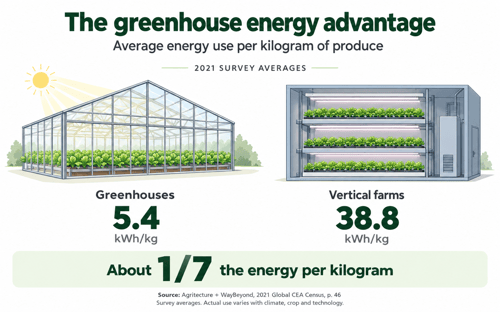
The gap is large. The 2021 Global CEA Census, which Agritecture ran with WayBeyond, found greenhouses averaged 5.4 kWh per kilogram of produce, while vertical farms averaged 38.8 kWh. That is about one-seventh of the energy for each kilo you sell. Newer research narrows the gap but doesn't close it. A 2025 review in Thermal Science and Engineering Progress puts today's vertical farms at 10–18 kWh per kilogram of lettuce, with a technical best case of 3.1–7.4 kWh as equipment improves. Even the low end of today's range is roughly double the Census greenhouse average.
One caution. In regions with cold, dark winters, greenhouses still need heating and supplemental lighting, so model your winter months separately rather than averaging them away. A 2024 Finnish life-cycle study found that in Nordic conditions, greenhouse lettuce running on average energy had the highest climate impact of the systems compared, and that the energy source and heat recovery mattered more than the farm type.
3. Proven technology with fewer points of failure
Commercial greenhouse growing has decades of track record, from the Netherlands to Spain to North America. The equipment, the crop recipes, and the people who know how to run them all exist.
Vertical farms stack more systems on top of each other, full artificial lighting, dehumidification, automation, and sometimes aeroponics or machine vision. Each one is a potential failure point. When the power goes out in a vertical farm, light and climate control fail together. In a greenhouse, the sun keeps shining, and growing systems with a large water volume, such as Deep Water Culture, buffer roots through an outage.
Technology is only half of resilience. The other half is people. We consistently advise clients to budget for an experienced head grower from day one, it costs less than the crop losses that come without one.
4. A smaller carbon footprint
Less artificial lighting and less HVAC mean lower emissions per kilo. A 2022 study by Blom and colleagues in the Journal of Cleaner Production found that lettuce from a Dutch vertical farm had a carbon footprint 5.6 to 16.7 times higher than conventional methods, including greenhouses, and still 2.3 to 3.3 times higher when renewable energy was assumed. Electricity made up 85% of the vertical farm's footprint. Agritecture's own analyses have found vertical farm footprints 2–5 times higher than greenhouses.
The gap is even wider for fruiting crops. A 2025 study in Sustainable Production and Consumption found that tomatoes grown in a vertical farm had four times the global warming impact of tomatoes from a high-tech greenhouse, 22.87 kg of CO₂-equivalent per kilogram, driven mainly by lighting. A May 2026 HortiDaily review of published studies put grid-powered vertical-farm lettuce at roughly 8–9 kg of CO₂-equivalent per kilogram, against about 1.2–1.5 kg for Dutch greenhouse lettuce.
The honest caveat: a greenhouse heated with natural gas in a cold climate can still carry a heavy footprint. The energy source matters as much as the structure. That leads to the next advantage.
5. Easier to run on renewable energy
Greenhouses pair naturally with on-site renewables because their main energy demand — heat — can be met in several ways:
- Solar PV on adjacent land or nearby roofs, either grid-tied or off-grid.
- Geothermal heat pumps for stable winter heating.
- Biomass boilers, especially on farms with their own organic residues.
- Wind, at open or coastal sites with consistent wind.
Solar can even become part of the greenhouse itself. A 2025 study in Applied Energy modeled greenhouses in Almería, Spain, and Agadir, Morocco, and found that covering 66% of the roof with semi-transparent solar modules could meet about half of heating needs, at the cost of roughly 12% lower tomato yields. It's a trade-off to model, not a free lunch.
Research by Ok-Youn Yu at Appalachian State University found that combining renewable and biomass heating with root-zone heating could cut greenhouse energy bills roughly in half.
6. A wider market and a clearer path to financing
Demand is growing. USDA's latest Census of Horticultural Specialties reports $1.01 billion in US sales of food crops grown under protection in 2024, up 44% from 2019. Private forecasts point the same way — IMARC projects the US greenhouse horticulture market to roughly double by 2034 — but they vary by definition, so treat them as directional.
Greenhouses can grow a broader range of crops than vertical farms, fruiting crops like tomatoes, cucumbers, peppers, and strawberries, not just leafy greens. More crops means more potential buyers: grocers, restaurants, institutions, and community supported agriculture (CSA) subscribers.
When is a greenhouse the wrong choice?
A greenhouse is a strong default, not a universal answer. We would steer a client elsewhere, or toward a different design, in these situations:
- Little usable daylight. At high latitudes, long winters erode the energy advantage.
- Hot, humid climates. Pad-and-fan evaporative cooling loses effectiveness as humidity rises, so tropical sites — including much of the Caribbean — need high-ventilation, shade-net, or naturally ventilated designs instead. Fan-free designs are one answer: McGill University researchers tested a naturally ventilated greenhouse with misting in Barbados and reported air cooling of up to 5 °C in tropical conditions.
- No affordable land. In dense city cores, a rooftop greenhouse or an indoor farm may be the only option.
- No committed buyers. AppHarvest built some of the largest high-tech greenhouses in the US, filed for Chapter 11 in July 2023, and was later liquidated. The company had posted operating losses since its inception. A greenhouse lowers your costs; it does not create a market.
Understanding CEA Investment Risks After the AeroFarms Collapse
How to start a greenhouse farm: 7 steps
- Secure your market before your structure. Talk to grocers, chefs, distributors, and institutions. Letters of intent beat assumptions.
- Choose crops by price and demand, not by what's easiest to grow.
- Match the greenhouse type to your climate — hoop house, polycarbonate, or glass — and decide how you'll heat, cool, and ventilate it.
- Assess the site: sunlight, water quality, power capacity, zoning, and distance to your buyers.
- Model the economics, including the bad scenarios. Winter energy costs, a 20% price drop, a slow ramp-up. Keep an operating reserve.
- Hire or contract a head grower early, before equipment is ordered.
- Match funding to risk: grants and cost-share programs, agricultural loans, and equity, in that order where possible.
For the full planning framework, see our Greenhouse business plan guide.
Two ways to take the next step
- Run the numbers yourself in Agritecture Designer - compare greenhouse, vertical, and container scenarios for your site at no cost. It's used in 45+ countries.
- Get an independent feasibility study. Agritecture is technology-agnostic and takes no vendor commissions. Book a consultation to test your site, crops, and financial model before you commit capital.
Frequently asked questions
Is a greenhouse farm profitable?
It can be, but the structure alone does not make it profitable. Where a site has usable daylight, Agritecture's analysis finds greenhouse economics almost always beat vertical farm economics, thanks to lower capital cost, lower energy use, and a wider crop range. Profit still depends on securing buyers before you build, choosing crops with strong local prices, controlling energy and labor, and hiring an experienced head grower.
How much does it cost to start a greenhouse farm?
Across Agritecture's project portfolio, commercial greenhouses typically cost $30–80 per square foot to build, compared with $100–300+ for indoor vertical farms. A 10,000 sq ft (about 930 m²) greenhouse would therefore cost roughly $300,000–800,000 before land, site works, and working capital. Simple hoop houses cost far less; high-tech glass greenhouses with full automation cost more.
Is a greenhouse better than a vertical farm?
For most sites with usable daylight, yes. In the 2021 Global CEA Census, greenhouses averaged 5.4 kWh of energy per kilogram of produce versus 38.8 kWh for vertical farms — about one-seventh. Vertical farms make sense when daylight is unavailable, when floor area is cheaper than land or roof area, or when a crop needs tighter control than a greenhouse can provide.
What crops grow best in a commercial greenhouse?
Common commercial greenhouse crops include tomatoes, cucumbers, peppers, leafy greens, herbs, strawberries, and cut flowers. The best crop is the one with reliable local demand and a price that covers your energy and labor costs, so start with buyer conversations rather than with what is easiest to grow.
Written by: Niko Simos
Based on a 2023 article by Sarah Jordan and Christian Kanlian.
Originally published March 24, 2023 · Updated October 28, 2026



.png)
