
 2 months ago
46

.jpeg)
.png)
Press play to listen to this article
Voice
A strong farm business plan can determine whether a lender, investor, grant provider, or development programme sees your agricultural idea as financeable or simply too risky to support.
Many African farmers understand production very well, yet struggle to present their farms as businesses because their knowledge remains in notebooks, conversations, spreadsheets, or personal experience.
The problem is not always the farming idea itself, the land available, or the demand for the product. Often, the missing piece is a professional document that converts the farming idea into measurable business evidence.
Think about a farmer such as Chibuzor from Enugu, who repeatedly requested agricultural financing but submitted only a simple description of his farm, proposed crop, location, and funding requirement.
Once his proposal included costs, revenue assumptions, market information, repayment planning, risks, and measurable targets, the application became easier to understand, assess, and discuss with potential financiers.
Read Also: Planning and Budgeting in Farm Business
🌿 Go Organic on Your Farm: Instead of harmful chemical pesticides and fertilisers, try our organic farming products — including neem oil spray, bio-pesticides, natural plant treatments, organic seeds and seedlings, suckers, and many more organic products that are safe for your health, your family, your soil and your harvest. Shop Now →
Farm Business Plan Basics That Matter

A farm business plan is more than a funding document because it explains how your agricultural enterprise will operate, make sales, control costs, manage risks, and create sustainable returns.
Before writing anything, understand that lenders are usually trying to answer a few practical questions. They want evidence that customers exist, management is capable, costs are realistic, and repayment is possible.
Your plan should therefore communicate facts rather than dreams. Production targets, selling prices, labour expenses, equipment costs, expected losses, and cash requirements should come from research instead of guesswork.
A useful business plan also helps you discover problems before investing heavily. When your projected expenses exceed realistic revenue, the document exposes the weakness while changes can still be made.
🔧 Free Farm Tool Available: Use our free Agric4Profits Farm Tools to calculate your farm profits, formulate feeds, identify pests and diseases on both your crops and animal farms, plan your planting and harvesting season, including many more farm tasks to get free expert advice and recommendations — completely free, no registration required. Access Free Tools →
Good planning requires understanding how scarce land, labour, capital, and management resources interact. This is why sound farm management principles should influence every major assumption in your plan.
A farmer should also understand that a business plan changes over time. Market prices shift, input costs rise, weather affects production, and customer preferences can change, requiring regular revisions.
Do not copy another farmer's plan and replace the name, location, and figures. Funders can quickly identify generic documents because the assumptions rarely match local production realities or business capacity.
Before approaching a funder, read the final document yourself several times. You should be able to explain every cost, production assumption, market claim, repayment figure, and operational milestone without depending completely on a consultant.
Farm Business Plan Structure Step by Step
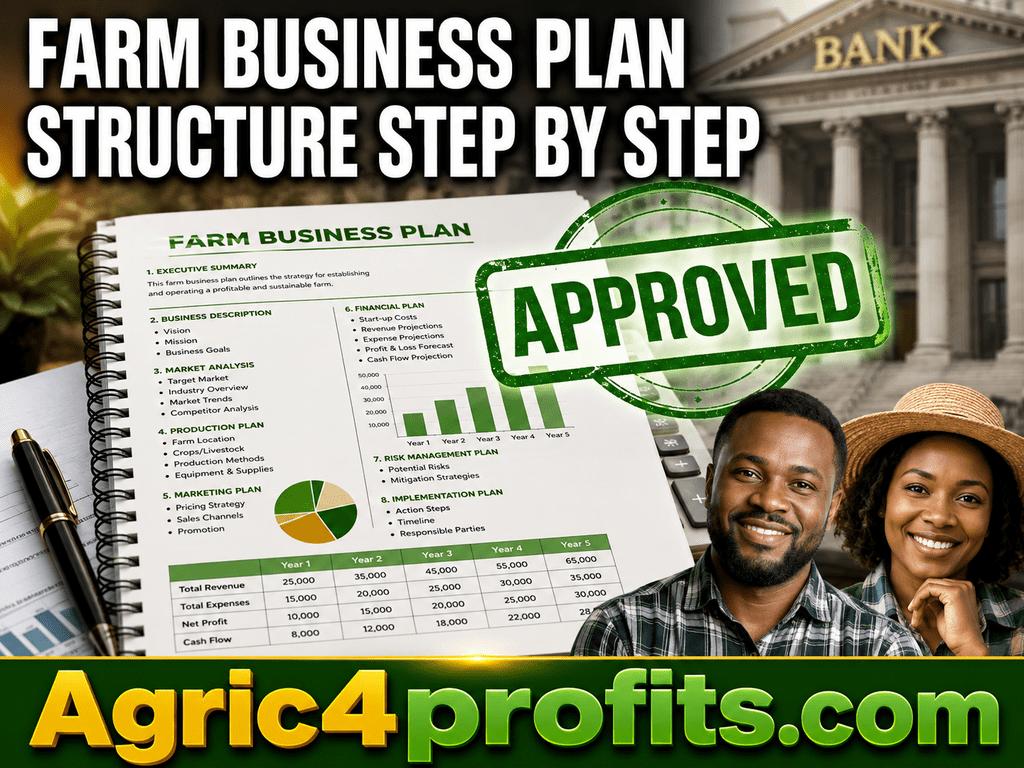
The structure of your plan matters because a clear sequence allows the reader to understand your farm from concept through operations, marketing, financial performance, funding requirements, and repayment capacity.
💬 Have a Farming Question? Join thousands of farmers across Africa on the Agric4Profits Community — ask questions, share experiences and connect with agricultural experts. It is completely free. Ask Your Question Now →
1. Executive Summary: Write this section last, although it appears first, because it should summarize your strongest information after every financial, operational, and market assumption has already been tested carefully.
The summary should introduce the farmer, enterprise, location, products, current stage, funding requirement, intended use of funds, expected returns, and the main reason the opportunity deserves consideration.
Keep the language direct and avoid unnecessary technical terms. A busy lender should understand what you are doing, how much capital you need, and what makes your enterprise commercially attractive quickly.
2. Business Description: Explain the farm name, ownership structure, registration status, location, land area, production history, management experience, enterprise type, assets already available, and future development direction.
Explain whether the farm is a new venture, an expanding existing operation, a partnership, cooperative, family enterprise, company, or individual business, because ownership affects responsibilities and decision-making.
3. Products and Services: Describe exactly what you will produce, expected production volumes, production cycles, quality standards, packaging options, processing activities, and any additional services connected with the agricultural enterprise.
A diversified farm should identify every major enterprise separately and explain how they interact. A poultry farm, for example, may earn from eggs, birds, manure, spent layers, and processed products.
4. Operations Plan: Explain land preparation, production methods, labour requirements, equipment, inputs, production schedules, storage, transport, harvesting, processing, quality control, and the responsibilities assigned to farm workers.
Detailed operational planning makes your proposal more credible because the reader can see how money will move from financing into productive activities rather than disappearing into unexplained expenses.
📖 Want to Go Deeper on This Topic?
Our expert agricultural ebooks cover poultry, fish farming, different crops production, snail farming, organic farming, mushrooms, sheep, cattle, flowers, pig farming, goat farming, agribusiness, etc. in practical step-by-step detail — written by agricultural professionals for African farmers.
5. Management Plan: Introduce the owner, farm manager, technical specialists, accountants, marketers, consultants, or cooperative partners involved in operating the enterprise and supporting important business decisions.
Describe responsibilities clearly so the funder understands who purchases inputs, supervises workers, records transactions, manages customers, controls cash, and monitors production performance throughout the farming cycle.
6. Financial Plan: Include startup costs, working capital, operating expenses, production revenue, gross profit, net profit, cash flow, break-even point, loan repayment obligations, and projected financial performance.
Your financial section should connect directly with your operations. If the plan says you will cultivate two hectares, the budget should reflect the realistic seed, fertilizer, labour, land preparation, transportation, harvesting, and marketing requirements.
7. Funding Request: State exactly how much capital you need, what type of financing you seek, how the money will be used, when it will be required, and how repayment will occur.
A convincing funding request does not simply say, “I need five million naira.” It explains each proposed expenditure and shows why that investment should increase productive capacity, revenue, or business efficiency.
Farm Business Plan Market Analysis

Market analysis is one of the sections that separates a serious farm business plan from a production-focused proposal because successful farming requires buyers, suitable prices, reliable distribution, and repeat demand.
Start by identifying your exact customer. Your buyers may include wholesalers, processors, supermarkets, restaurants, schools, hotels, exporters, households, livestock farmers, retailers, or food manufacturers.
Research current selling prices instead of relying on assumptions from previous seasons. Prices vary between locations, seasons, quality grades, farmgate sales, wholesale markets, processing companies, and direct consumer channels.
Your research should also identify competing producers. Study how they price, package, distribute, promote, and differentiate their products so you can identify opportunities rather than simply entering an overcrowded market.
A strong plan should explain the specific customer problem you solve. Your advantage may involve reliable supply, better grading, shorter delivery times, cleaner packaging, consistent quality, processing, traceability, or stronger customer service.
Use agricultural marketing principles to understand how farm products move from producers toward consumers and how market decisions influence the eventual value captured by your business.
You should also estimate your reachable market rather than claiming that everyone in Africa is your customer. Define a practical geographic area, customer group, purchase frequency, expected order size, and realistic market share.
Where possible, collect evidence through interviews, market visits, buyer quotations, historical farm records, cooperative information, processor requirements, local price observations, and written expressions of interest from potential customers.
Explain how you will respond when prices fall. Your plan may include staggered planting, contract sales, storage, processing, multiple customer segments, product diversification, or alternative markets that reduce dependence on one buyer.
Strong market research can also reveal opportunities for processing, transportation, grading, storage, and other marketing activities that improve how agricultural products reach their final customers.
Farm Business Plan Financial Projections
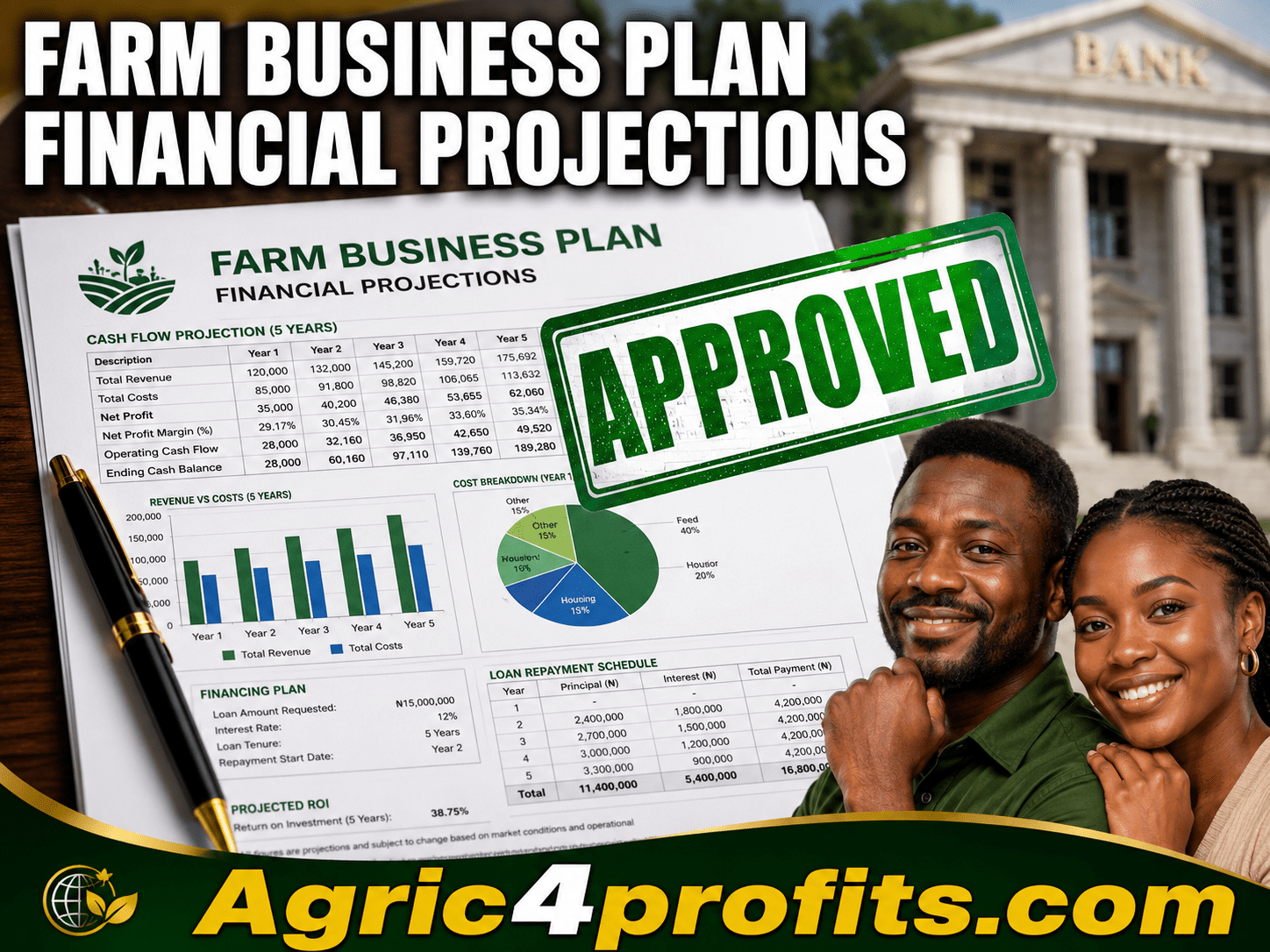
Financial projections receive serious attention because they show whether your farm can generate enough income to survive operations, repay financing, replace assets, and eventually provide attractive returns.
1. Startup Costs: List every initial expenditure separately, including land preparation, construction, equipment, livestock, seedlings, seeds, irrigation, fencing, water systems, storage, registration, transport, and initial working capital.
Do not hide expenses inside vague categories such as “miscellaneous farming costs.” A lender needs to understand what each naira, shilling, cedi, birr, or rand will actually finance.
2. Operating Costs: Separate recurring expenses from fixed investments. Feed, seed, fertilizer, labour, electricity, fuel, medicines, packaging, transport, repairs, communication, marketing, insurance, and administration should be considered carefully.
Use realistic quotations wherever possible. Farm financial calculations become more useful when your estimates are based on actual supplier prices, local wages, realistic yields, and current market conditions.
3. Revenue Projection: Calculate revenue by multiplying realistic selling quantities by realistic prices. Avoid assuming that every unit produced will be sold immediately at the highest market price.
Account for mortality, rejected produce, post-harvest losses, quality differences, seasonal discounts, unsold stock, delayed payments, and periods when production is naturally below capacity.
4. Profit Projection: Show expected gross profit and net profit for at least three years, explaining how production efficiency, customer growth, price changes, expansion, or cost reductions influence the numbers.
A credible three-year projection can show a modest first year, improving second year, and stronger third year. This progression is usually more believable than immediate extraordinary profits without operational evidence.
5. Cash Flow Statement: Track when money enters and leaves the farm because profitable businesses can still fail when cash arrives after bills, loan repayments, salaries, feed purchases, or seasonal expenses become due.
6. Break-Even Analysis: Determine the production or sales level required to cover your costs. The break-even calculation helps you understand how much must be sold before the business begins generating operating profit.
7. Return on Investment: Calculate expected returns against the capital invested, but explain your assumptions. A large projected return without evidence can damage credibility instead of strengthening your funding application.
8. Scenario Analysis: Include realistic, optimistic, and difficult scenarios covering lower selling prices, production losses, higher input costs, delayed payments, disease outbreaks, or weaker demand.
The commercial farm planning framework also demonstrates why financial projections should connect revenue, costs, cash flow, profitability, and lender-oriented measurements rather than presenting isolated figures without relationships.
Farm Business Plan Risks And Management
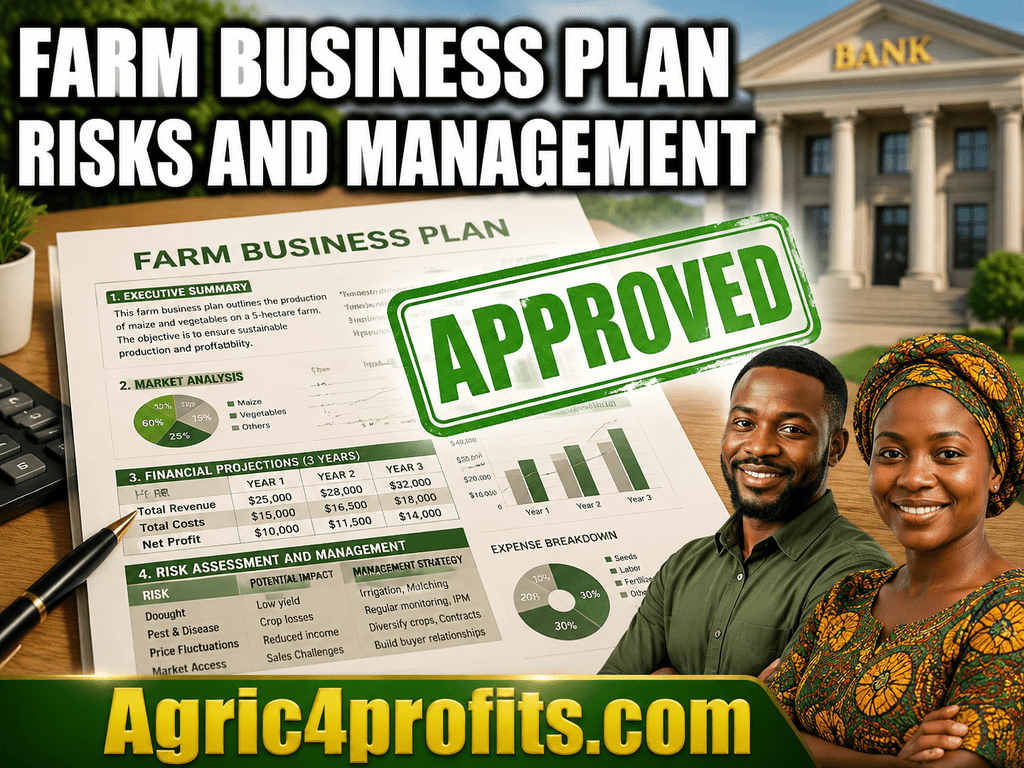
Every agricultural enterprise carries risk, so pretending your farm will operate without problems can make your business plan appear inexperienced and unrealistic to knowledgeable lenders or investors.
1. Production Risk: Identify drought, flooding, pests, diseases, poor-quality inputs, livestock mortality, machinery breakdown, weak genetics, water shortages, and other events that could reduce output or raise production costs.
Then explain how you will reduce those risks through appropriate varieties, vaccination, biosecurity, irrigation, drainage, preventive maintenance, technical advice, improved housing, production monitoring, or diversification.
2. Market Risk: Consider price volatility, changing consumer preferences, new competitors, buyer concentration, transportation disruptions, seasonal oversupply, and sudden changes in market access.
A practical response could involve forward contracts, multiple buyers, customer deposits, processing, product differentiation, storage, staggered harvesting, or direct marketing rather than relying entirely on one open market.
3. Financial Risk: Explain how the farm will manage interest obligations, repayment pressure, cost increases, delayed customer payments, unexpected expenses, and periods when income falls below projected levels.
Consider building working-capital reserves, matching repayment schedules to farm cash cycles, limiting unnecessary borrowing, and maintaining accurate records. The risks associated with farm financing deserve explicit attention.
4. Climate Risk: Agricultural businesses should evaluate rainfall changes, extreme heat, storms, erosion, flooding, drought, and changing production seasons when preparing their operational and financial assumptions.
Climate risk management can include irrigation, improved water storage, suitable crop choices, conservation practices, shade, drainage, soil management, insurance, diversified enterprises, and carefully timed production cycles.
5. Insurance Strategy: Where appropriate and financially practical, explain whether agricultural insurance can protect the enterprise against major losses and how insurance costs affect your annual budget.
For Nigerian farmers, a business plan can discuss relevant coverage options alongside other financing protections. Agricultural insurance planning can strengthen a funding proposal by showing that catastrophic risks have been considered.
6. Management Risk: Identify risks created by weak supervision, inaccurate records, poor purchasing controls, labour turnover, inadequate technical skills, or unclear responsibilities between farm owners and workers.
Clear roles, regular reporting, production records, approval procedures, inventory checks, financial controls, and management meetings can reduce losses created by internal weaknesses within the farm.
7. Contingency Planning: Explain what you will do if production falls below target, a major buyer disappears, costs increase sharply, or financing arrives later than expected.
A strong contingency plan gives the reader confidence because it proves you have considered difficult outcomes. It also gives you practical choices before a crisis becomes an emergency.
Accurate records strengthen every risk calculation because you can compare actual performance against projections. Proper farm recordkeeping provides evidence for future decisions, lender discussions, insurance claims, and business reviews.
Farm Funding Applications That Look Credible

A strong business plan improves your funding application, but the document should be built around the specific requirements of the institution, programme, investor, lender, cooperative, or grant opportunity you are approaching.
1. Match Funding To Purpose: Use short-term financing for suitable working-capital needs and longer-term financing for assets whose useful life and revenue contribution extend across several production cycles.
Borrowing should have a productive purpose. Financing land development, irrigation, machinery, livestock, processing equipment, working capital, or storage should connect clearly to measurable business outcomes.
2. Request A Defensible Amount: Never inflate your funding request simply because you assume a larger number will produce a larger business. Request what the project can reasonably absorb and repay.
Funders often prefer applications where the requested amount aligns with budgets, production capacity, market demand, management ability, and realistic implementation timelines.
3. Show Your Contribution: Explain what you are already providing through land, labour, equipment, existing livestock, buildings, working capital, market relationships, experience, or other resources.
A demonstrated contribution can help communicate commitment, reduce the amount of external capital required, and show that the entrepreneur has already invested something meaningful in the proposed venture.
4. Explain Repayment Clearly: State when income should begin, when major harvests or sales are expected, what percentage of projected cash flow can support repayments, and what happens during lower-income periods.
Repayment schedules should follow agricultural realities. A crop farmer may generate significant cash after harvest, while a livestock producer could have more frequent sales depending on the production model.
5. Prepare Supporting Evidence: Gather land documents, registration papers, supplier quotations, customer letters, bank statements, production records, tax information, identification documents, licenses, photographs, and relevant technical certifications.
Documents should support the claims inside your plan. A projected equipment cost becomes stronger when accompanied by a supplier quotation rather than an unsupported estimate copied from another business proposal.
6. Follow Current Programme Rules: Funding opportunities change, application windows close, eligibility requirements are revised, and programme names can shift. Always verify current conditions directly with the institution before applying.
For example, NIRSAL Microfinance Bank currently lists agricultural finance for crop farming, animal husbandry, fish farming, and farm produce processing, while its website also lists AGSMEIS and Anchor Borrowers Programme products.
In Nigeria, the Bank of Agriculture remains a major agricultural development finance institution, while recent BOA notices also warn applicants to rely on official channels because fraudulent funding announcements circulate online.
Across Africa, opportunities differ substantially by country. The Tony Elumelu Foundation's 2026 programme provides US$5,000 in non-refundable seed capital, training, mentorship, and entrepreneurial support for selected African entrepreneurs.
7. Use Professional Tools: A structured planning tool can reduce calculation mistakes and help organize budgets, revenue assumptions, markets, and operational milestones before you submit the final document.
The Agric4Profits FarmSmart Business Planner provides a guided process for budget inputs, farm recommendations, cost breakdowns, revenue projections, market strategy, and business-plan preparation for African farming enterprises.
8. Review Before Submission: Check every number, date, spelling, attachment, quotation, market assumption, and repayment calculation before submitting. A polished document can still fail when supporting information contradicts its financial projections.
A professional review should also confirm that your farm management approach matches your proposed production scale, labour structure, resource availability, monitoring system, and operational targets.
Farm Business Plan Mistakes To Avoid

The easiest way to improve your business plan is to understand why otherwise promising applications fail. Many problems are not caused by poor farming ideas but by weak documentation, unrealistic assumptions, or missing evidence.
1. Unrealistic Profits: Do not promise extraordinary returns without showing the production figures, selling prices, costs, customer demand, and operational capability required to generate those results.
When projected profits look dramatically higher than common industry performance, the reviewer may question the assumptions. Conservative figures often communicate stronger business judgement than exaggerated promises.
2. Missing Market Evidence: Saying “there is a big market for this product” is not enough. Identify customers, volumes, prices, competitors, distribution channels, purchasing patterns, and reasons buyers will choose your product.
3. Incomplete Costing: Farmers sometimes include seeds, feed, fertilizer, or livestock purchases but forget transportation, labour supervision, packaging, storage, repairs, mortality, utilities, marketing, insurance, taxes, or administrative expenses.
The economic principles of farm management remind farmers that resource allocation and marginal returns matter, meaning spending should be connected to expected productive and financial outcomes.
4. No Cash Flow: A profit projection alone cannot show whether you have enough money available to pay bills when they become due. Cash-flow timing is especially important in seasonal agriculture.
5. Ignoring Competition: Never claim that your farm has no competitors. Strong businesses understand competitors and explain how quality, cost, reliability, location, technology, branding, service, or specialization creates an advantage.
6. Weak Management Information: Describe who will run the operation and why they are qualified. Investors need confidence that the people responsible for production, finances, marketing, and administration can execute the plan.
Management responsibilities become stronger when supported by clear supervision and delegation systems that define who gives instructions, monitors workers, approves activities, and reports operational performance.
7. No Personal Contribution: Depending entirely on external money can make the proposal appear fragile. Explain your own resources and demonstrate where practical contributions are already available.
8. Poor Presentation: Spelling mistakes, inconsistent numbers, missing pages, unclear tables, unreadable scans, unexplained calculations, and unsupported claims reduce confidence in your professionalism.
Your final plan should be easy to navigate, financially consistent, clearly structured, and supported by evidence. The basic principles of farm management can also help you evaluate whether the proposed business uses scarce resources efficiently.
Remember that planning should continue after funding. Compare actual performance against your projections each month, identify variances, update assumptions, and adjust production or marketing decisions before small problems become major losses.
Regular business reviews are easier when farmers maintain accurate records, monitor profitability, and understand the relationship between production decisions and financial results. A plan should guide action rather than sit forgotten inside a funding application folder.
For additional market planning, stronger agricultural marketing strategies can help you improve customer targeting, market access, promotional decisions, and the commercial positioning of your farm products.
A business plan becomes more valuable when it reflects the real farm. Your land, experience, customers, production methods, financial capacity, risks, and local market conditions should all influence the final document.
Before submission, compare the financial tables with your written narrative. If one section says you will produce 10 tonnes while another section uses 15 tonnes for revenue calculations, correct the contradiction immediately.
Also ensure that your market strategy supports your production volume. If your plan proposes a large harvest but identifies only one small buyer, explain how the remaining output will reach customers or reduce the imbalance.
Farmers can also explore ways to understand agricultural marketing surplus and pricing relationships when estimating the difference between farm-level prices and downstream market values.
Finally, treat the document as a management instrument. Use it to measure progress, control spending, plan staffing, negotiate financing, evaluate expansion opportunities, and decide when an agricultural enterprise should be adjusted.
Once you have a complete draft, test it using one final question: could an unfamiliar reader understand exactly how the farm will use money, generate sales, manage risks, and repay financing without needing verbal explanations?
The strongest business plans answer that question clearly. They combine practical farming knowledge with disciplined financial planning, credible markets, measurable operations, realistic risks, and a funding request that matches the business's actual capacity.
Read Also: Agricultural Financing and Farm Loans in Africa
Summary on How to Write a Farm Business Plan That Gets You Funding in Africa (Step-by-Step Guide)
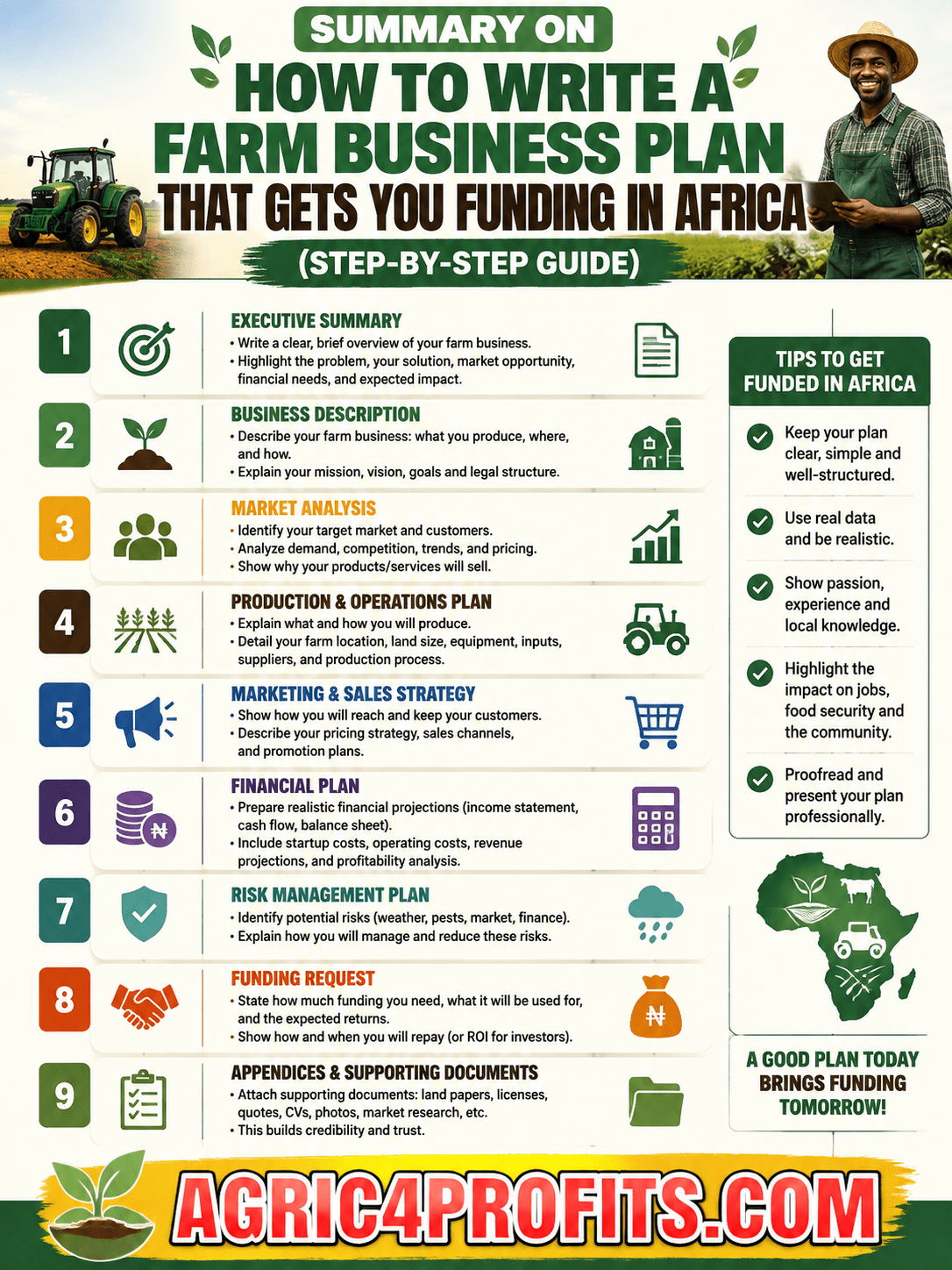
| Executive Summary | Farmer, farm, location, products, funding need, purpose, returns | Gives the funder a quick understanding of the opportunity |
| Business Description | Ownership, registration, location, history, size, management | Establishes the identity and structure of the agricultural business |
| Market Analysis | Customers, prices, competitors, demand, market channels | Shows that the farm has realistic opportunities to generate sales |
| Products and Operations | Production process, quantities, cycles, labour, equipment, quality | Explains how the business will convert resources into products |
| Marketing Strategy | Pricing, distribution, promotion, customer acquisition, differentiation | Shows how products will reach buyers and generate revenue |
| Financial Projections | Startup costs, operating costs, revenue, profit, cash flow, break-even | Helps funders assess financial viability and repayment capacity |
| Risk Management | Production, market, climate, financial, management, insurance risks | Shows preparedness for conditions that could reduce business performance |
| Funding Request | Amount, purpose, financing type, repayment plan, applicant contribution | Explains exactly what financing is needed and how it will be used |
| Supporting Evidence | Quotations, records, land documents, registrations, buyer evidence | Strengthens the credibility of assumptions and business claims |
| Final Review | Consistency, grammar, calculations, attachments, current programme rules | Reduces avoidable rejection caused by errors and incomplete information |
Frequently Asked Questions About How to Write a Farm Business Plan That Gets Funding
1. What should a farm business plan include when applying for agricultural funding from banks, investors, government programmes, cooperatives, and grant providers across African countries?
A complete plan should include the business description, products, market analysis, operations, management, financial projections, risks, funding request, repayment strategy, and supporting evidence.
2. How many pages should a farm business plan have when preparing a serious funding application without making the document unnecessarily complicated for the reviewer?
There is no universal page requirement. Focus on completeness, clarity, evidence, and readability rather than length. A concise, detailed plan is better than unnecessary pages filled with repetition.
3. Should a farmer write the farm business plan personally or hire a consultant to prepare a professional document for funding applications?
A consultant can help with structure and financial modelling, but the farmer should actively provide the assumptions and understand every figure because lenders may ask detailed questions.
4. What financial information should be included when creating projections for a farm business plan intended for agricultural loans or investment funding?
Include startup costs, operating expenses, expected revenue, gross profit, net profit, cash flow, break-even analysis, return on investment, financing costs, and realistic downside scenarios.
5. Can a smallholder farmer with limited capital still prepare a credible farm business plan without owning large commercial farmland or expensive equipment?
Yes. A good plan reflects the actual scale of the enterprise. Land size, existing assets, production capacity, customer base, and financing needs should match the farmer's current situation.
6. How important is market research when writing a farm business plan for agricultural funding in Nigeria, Ghana, Kenya, Uganda, and other African markets?
Market research is critical because funders need evidence that customers exist, prices are realistic, competitors are understood, and the planned production volume can be sold profitably.
7. Can a farm business plan be used for both grants and loans even though those funding sources have different financial expectations and repayment requirements?
Yes. The core plan can remain similar, but the funding request, use of funds, milestones, reporting requirements, and repayment section should be adapted to each funding opportunity.
8. How often should a farmer update a farm business plan after receiving financing and starting production activities on the agricultural enterprise?
Review the plan regularly, especially after major production cycles, price changes, new financing, equipment purchases, market changes, or significant differences between projected and actual financial performance.
9. Where can African farmers find current agricultural funding opportunities and verify whether a loan, grant, or entrepreneurship programme is genuinely open?
Check the official websites of banks, ministries, development institutions, foundations, and programme operators. Avoid relying on forwarded messages, unofficial agents, or websites promising guaranteed approval.
10. What is the biggest mistake farmers make when writing a farm business plan that eventually causes rejection even when the underlying farming idea appears profitable?
The biggest mistake is presenting unsupported assumptions. A promising farm idea can still fail review when costs, production, market demand, cash flow, repayment capacity, or funding requirements are incomplete.
Do you have any questions, suggestions, or contributions? If so, please feel free to use the comment box below to share your thoughts. We also encourage you to kindly share this information with others who might benefit from it. Since we can’t reach everyone at once, we truly appreciate your help in spreading the word. Thank you very much for your support and for sharing!
Read Also: How Long Does It Take a Hazelnut Tree to Produce Nuts?

.png)
